The ability to access Home Assistant remotely makes the smart home even smarter. There are several ways to do this, such as Wireshark, classic VPN, tailscale or via Cloudflare Tunnel. However, all of these methods require technical expertise and a certain amount of configuration work, as well as ruling out the use of Alexa & Co. This requires the Home Assistant instance to be accessible from the internet, which is why only self-hosted reverse proxies remain, which are available as a Home Assistant add-on (e.g. Nginx Proxy Manager). This can then be “hidden” behind a free Cloudflare proxy and thus further secured (which is my approach, by the way).
The commercial part behind Home Assistant, the company Nabu Casa, has long offered a service that makes this much easier. For currently €7.50 per month or €75 per year, the Home Assistant Cloud gives you encrypted and secure access to your Home Assistant installation, as well as a practical plug-and-play solution for voice assistants such as Amazon Alexa or Google Assistant. It also provides financial support for the further development of Home Assistant.
Homeway.io - the affordable Nabu Casa alternative?#
Homeway.io , a service that is comparable to Nabu Casa and positions itself as a low-cost alternative, has been available for some time now. The entry-level version is even free of charge. However, the provider talks about “throttled speed” and “data limits” without specifying these more precisely. In addition, the free version does not include Alexa or Google Assistant integration.
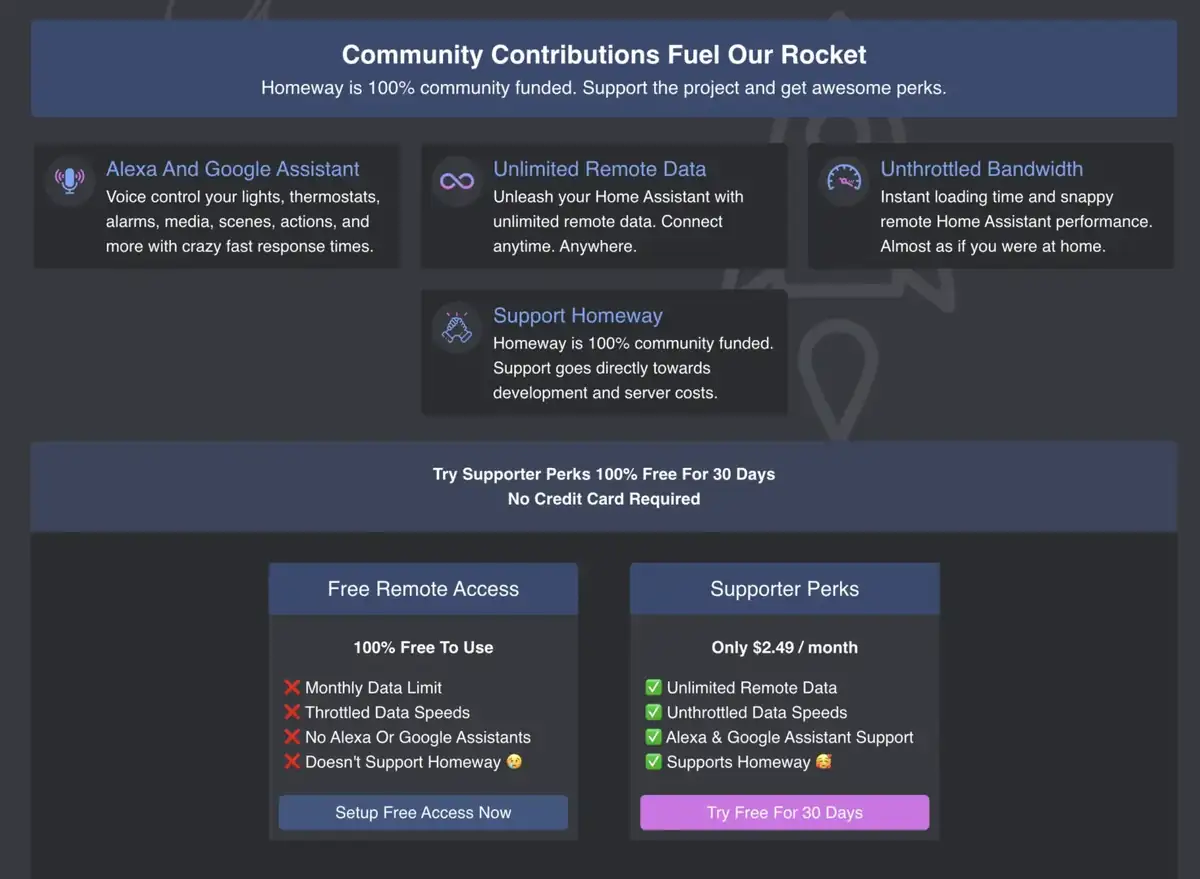
In this case, you have to opt for a paid version, which at $2.49 per month is significantly cheaper than the offer from Nabu Casa. As of today, $2.49 is just €2.20 - and the trend is downwards. The paid version can be tested free of charge for 30 days.
The prerequisite for operation is an add-on, which must be installed in Home Assistant, but which is also available as a separate Docker container (Home Assistant add-ons are basically just Docker containers). You then use it to connect to your previously created Homeway.io account, and you can access Home Assistant remotely and use voice assistants.
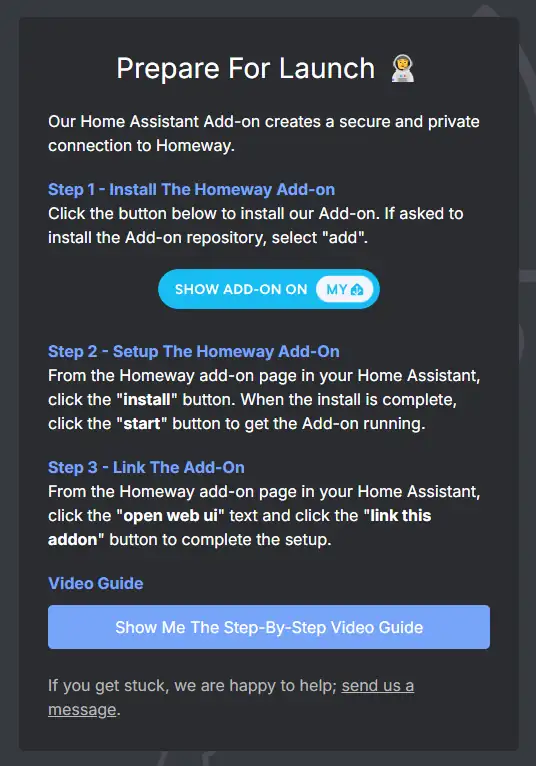
I tried out Homeway.io, and it’s actually straightforward to set up. You then select the Homeway.io skill in the Alexa app, and this also gives you Alexa control. However, all entities are published to Alexa and I have not found a way to restrict this beforehand. With Nabu Casa, the user interface can be used to configure which entities Alexa should know, and if you manually integrate Alexa into Home Assistant, this can be restricted via Configuration.yaml .
With “Sage”, Homeway.io also offers the connection to AI services such as OpenAI, Google Gemini and Anthropic for Home Assistant. This is already included in the paid version of Homeway.
Little transparency about the makers behind Homeway.io#
What bothers me about Homeway.io is that you don’t know who you’re dealing with. There is no address, no company headquarters, no names on the site. You don’t find out which services are used and where the servers are located. Where the $2.49 fee goes is just as nebulous and there are no taxes if you subscribe to the service as an EU citizen. All you learn is that Homeway.io is a single developer, even if they like to talk about a “community”.
On Reddit and in Homeway.io’s Discord channel, you can read about problems and outages with the service, as well as sluggish reactions when using Alexa. But there are also many positive voices. To be fair, I also noticed that the Home Assistant Cloud processes my voice commands much more slowly than my manual integration without Nabu Casa can.
What Homeway.io and 3D printers have in common#
It’s interesting to note that Homeway.io is probably the same developer behind the 3D printer service https://octoeverywhere.com/ . I emailed Homeway’s support address and asked for information about the company’s location, server locations and integrated third-party services. I then received an automated response from “Helix from OctoEverywhere”, coupled with a note that I would first need to submit the request via their messenger/chatbot on the website. The websites of Homeway.io and OctoEverywhere look very similar.

With this information, I then found an interview with the developer of OctoEverywhere and therefore the presumed brains behind Homeway.io. His name is Quinn Damerell.
Once you have his name, you find his remarkable GitHub repository and learn that he lives in Seattle/USA. Quinn is also the brains behind the 3D printer interfaces Mainsail, Fluidd and Moonraker, which I even use myself with my 3D printers. He is clearly a very capable developer, as his other projects are widely used and highly recognized in the 3D printing scene. On this basis, he can only be credited with the best of intentions.
It is also important to realize that in the USA - unlike in Germany - there is no obligation to publish an imprint, and it is even frowned upon in some cases. However, when it comes to cloud services that grant access to Home Assistant, you would like to know who you are dealing with and what technology is behind it. In addition, the Federal Trade Commission (FTC) in the USA requires every company to publish a physical address, company name, telephone number and email address on its website. The extent to which this will still apply under the orange Clown in Washington is questionable.
Conclusion#
Is Homeway.io a cheaper alternative to Home Assistant’s Nabu Casa? It is definitely cheaper and it will get cheaper if the dollar continues to fall. Setting up Homeway.io is straightforward and is explained step by step. There are even video tutorials to help if required.
In theory, Homeway even has a security advantage because, unlike Nabu Casa, it does not make the addresses of the individual Home Assistant instances visible on the Internet. With a simple search on Bing, using site:ui.nabu.casa, you get pages of addresses of accessible Home Assistant instances, from whose access only more or less strong passwords separate them.
With Homeway.io, these addresses can only be viewed via the Homeway user account. This can also be additionally secured using two-factor authentication.
On the negative side, there is little transparency regarding the provider and the services it uses, as well as reports of poor performance. Of course, it is always a risk to rely on a service that is only backed by one person. In an emergency, you can, of course, switch to Nabu Casa, as this would involve very little effort.
Of course, I’m delighted when other offers and services are created around Home Assistant, and Homeway.io is definitely interesting.
I have asked Homeway.io for clarification about the company’s headquarters, third-party services used, etc. and will let you know as soon as I receive an answer.
More info: https://homeway.io